UK e-Invoicing Mandate 2029: A guide for construction
A clear guide for construction leaders
From 1 April 2029, VAT invoices between UK businesses, and to government, must be exchanged as structured data. A PDF sent by email will no longer count as the legal invoice on its own.
The detail is still developing, but the direction is clear. You can start preparing today.
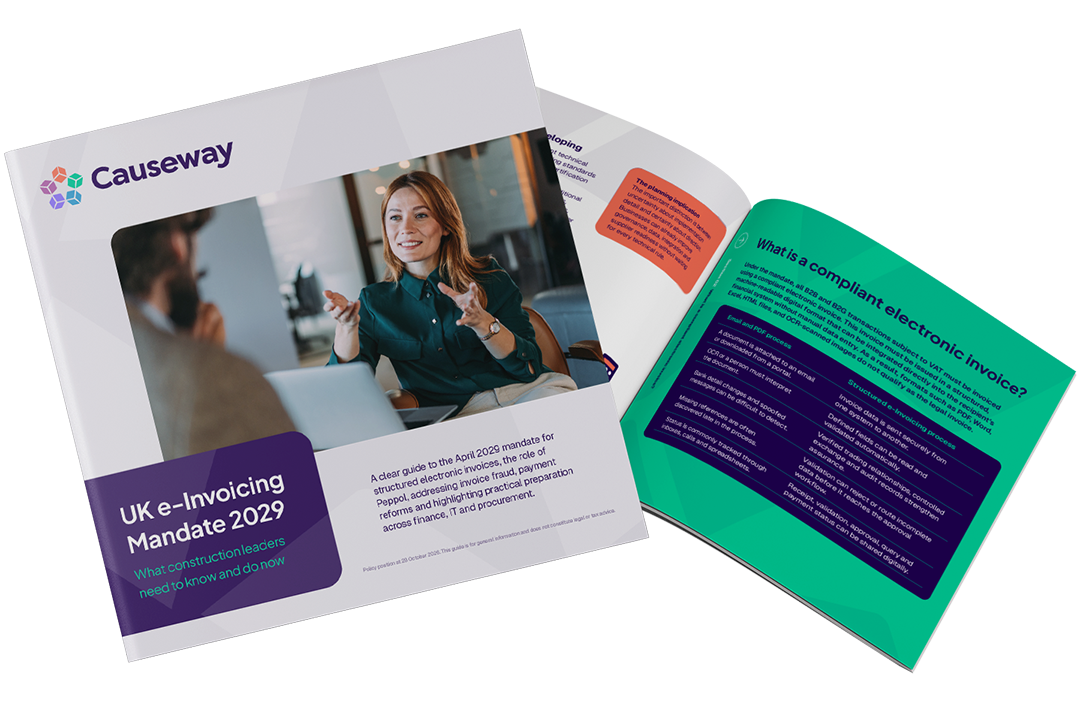
What does the UK e-Invoicing mandate guide cover?
-
What a compliant electronic invoice looks like, and why converting a PDF is a stepping stone
-
How Peppol and the four-corner exchange model work
-
Which construction issues need an answer, from applications and certificates to goods and service evidence
-
How the mandate fits with the Fair Payment Code and the Commercial Payments Bill
-
Five steps to prepare, with milestones from now to April 2029

UK e-Invoicing mandate questions answered
Peppol is an international interoperability framework for the secure exchange of standardised business documents between organisations using different systems and providers. The UK Government has confirmed it as the core framework for UK e-Invoicing. Businesses will choose their own compliant service providers, as no single central government invoicing portal is planned.
Mandatory e-Invoicing begins on 1 April 2029 for VAT invoices in scope. It covers business-to-business and business-to-government transactions. Detailed requirements, standards and exemptions will be published between October 2027 and April 2028, and affected organisations will receive at least 12 months’ notice of final requirements.
No, not on its own. From 1 April 2029, the legal invoice for in-scope transactions must be exchanged as structured, machine-readable data that systems can read, validate and process. PDF, Word, Excel, HTML and OCR-scanned images do not qualify. A service can convert a PDF, but treat that as a migration route, not the end goal.
Start with five steps: name an executive sponsor, map every invoice channel, test your invoice data quality, assess whether your ERP can exchange structured invoices, and segment suppliers by digital capability. Each step should produce evidence leaders can review, so you can see your strongest foundations and the gaps to close.